





Solving Cross-Jurisdictional Crime in Real Time: How Flock’s Unified Platform Makes It Possible
Learn how Flock helps law enforcement agencies solve cross-jurisdictional crime in real time to locate suspects faster, with agency-controlled sharing, real-time alerts, and full audit trails on one platform.

Crime doesn’t stop at city limits, and investigations may not stay in one place. When a suspect vehicle crosses from one jurisdiction into the next, an investigation can stall because the vehicle evidence sits in another agency’s system.
Law enforcement agencies share vehicle data across jurisdictions by opting into a connected license plate reader (LPR) network, where each agency controls who can search their data and why. When a vehicle of interest passes a participating camera in a partner jurisdiction, investigators get a real-time alert or can search shared detections. They then coordinate the response. Every search is logged with a reason, so oversight comes along with the data.
This guide explains how that works on a unified platform, what regional task forces gain from it, and what to look for when evaluating a shared-data platform.
How Do Law Enforcement Agencies Share Vehicle Data Across Jurisdictions?
On the Flock platform, cross-jurisdiction sharing follows a consistent sequence:
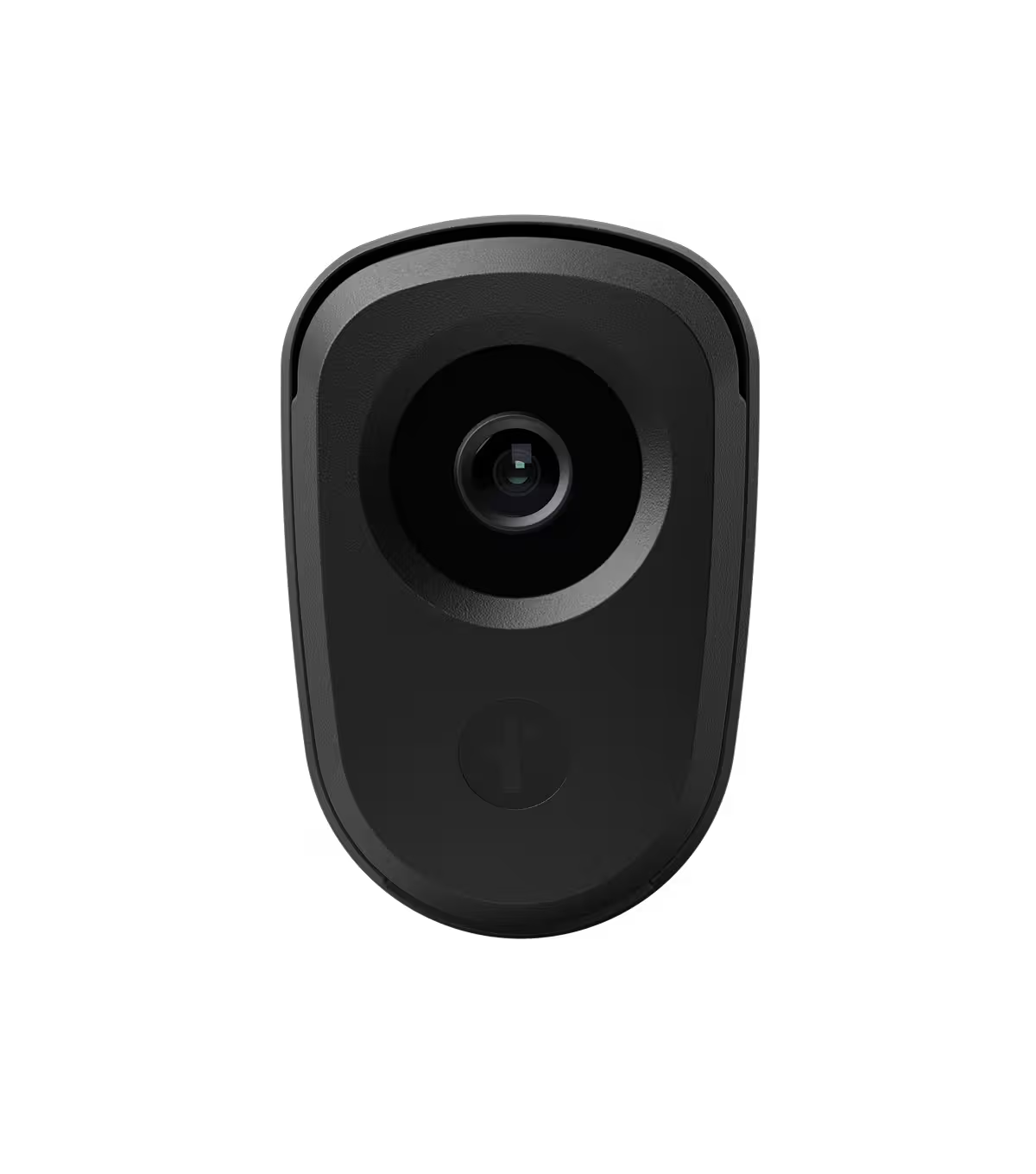
- Each agency captures and owns its own data. When a vehicle passes a Flock LPR camera, the camera captures a series of still images of the vehicle. It processes them for details like the vehicle’s make, color, direction of travel, time, location, and when visible, the license plate. The agency that deploys the camera owns that data and sets its retention period. Flock recommends a 7-day retention period.
- Agencies opt in to sharing and set the rules. Nothing is shared automatically. Each agency chooses whether to join network sharing, which partners can access its cameras, and, with offense filtering, which offense types partners may search for.
- Alerts are sent across shared cameras in real time. When a vehicle on a customer-defined or NCIC hot list passes a camera in a partner-jurisdiction, authorized users receive an alert. Before an alert goes out, the system matches both the plate and the issuing state against the hot list record and filters out low-confidence reads.
- Investigators search the shared network. Users can search full, partial, or temporary plates, or describe the vehicle when there is no plate at all.
- Partner agencies coordinate. In FlockOS, alerts, nearby cameras, live video, and CAD calls sit in one view. The responding agency doesn’t need to call around for context.
- Every search is documented and reviewable. Each search requires an offense type and case code and is tied to a specific user. The owning agency’s supervisors can review the logs.
One principle sits under every step: an alert is a lead, not a conclusion. An officer visually confirms the plate and makes sure any stop follows the law and agency policy before acting. For a deeper look at the process, see how an automatic license plate recognition system works.
Why Disconnected Systems Can Slow Multi-Agency Investigations
Many agencies still use LPR, video, and dispatch as separate tools, each with its own login. While manageable within one department, it can break down when multiple agencies are working the same suspect vehicle across county or state lines.
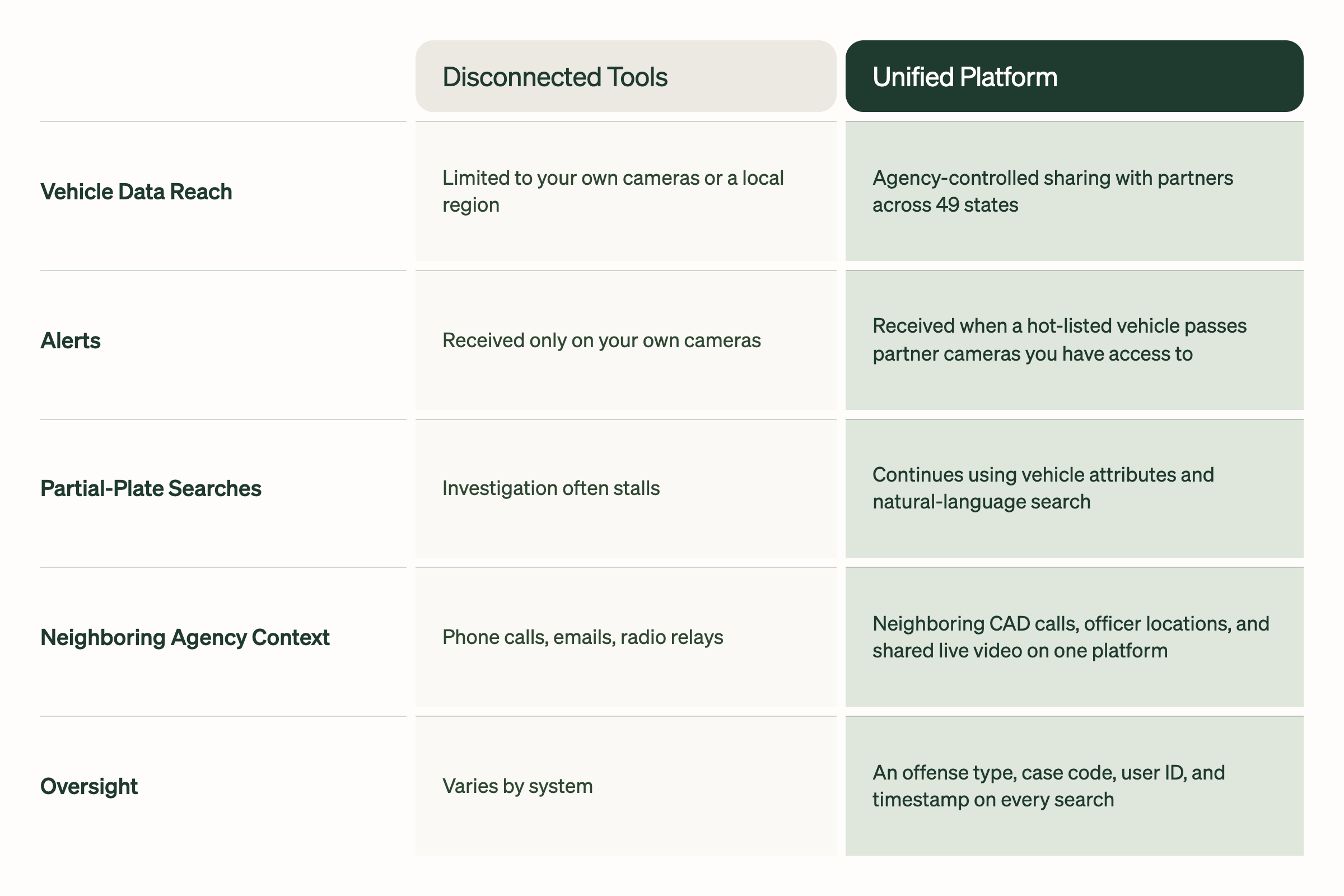
Every handoff between systems or agencies costs time, and with a moving vehicle, time is what an investigation has least of.
What a Unified Platform Means For Cross-Jurisdictional Crime
A shared LPR network with local control
Flock operates the nation’s largest connected LPR network across 49 states. Thousands of law enforcement agencies take part in controlled sharing. In 2025, Flock supported more than 1 million cases and helped locate more than 10,000 missing people. For agencies working together, that reach means a lead can be followed past its own boundaries, while each agency stays in control of its own data.
Real-time alerts across partner jurisdictions
When a stolen vehicle, a missing person’s vehicle, or a suspect’s vehicle passes a camera your agency can access, the alert reaches officers in FlockOS and the Flock mobile app. A coordinated multi-agency response can start in seconds rather than after a chain of phone calls.
Search that works without a full plate
Multi-agency cases often start with a witness description, a partial tag, or a plate fragment from video. Flock’s Vehicle Signature technology captures attributes such as make, body type, color, bumper stickers, or roof racks. Flock FreeForm lets investigators search shared networks in plain language instead of rigid filters. Learn more about vehicle recognition software for investigation-grade LPR.
Real-time routing from the LPR hit
When a suspect vehicle triggers an LPR alert, FlockOS shows its direction of travel and highlights routes and nearby cameras. Units in neighboring jurisdictions can then position themselves to intercept rather than piece together clues after the fact.
Neighboring agency context and integration
FlockOS can show live CAD calls from surrounding jurisdictions, even if your own agency doesn’t have a CAD integration. It can also show officer and vehicle locations from partner agencies, and live and recorded video from cameras owned by neighboring agencies, schools, and traffic systems that have been shared. Agencies rarely share one vendor stack, so Flock supports an open API, third-party cameras and devices, and viewing multiple CAD instances in one place.
Beyond the vehicle data: 911 audio and drone response
The same platform carries other real-time signals that help partner agencies respond. Flock911 streams live 911 caller audio, transcripts, and location into FlockOS. In Georgia, a Warner Robins PD lieutenant heard a live call from neighboring Houston County about a person armed with a shotgun. He was already on scene when Houston County requested mutual aid. Flock DFR adds live aerial video that dispatch, field units, and partner agencies can view together when access is configured.
How Agencies Stay in Control of Shared Data
For a task force lead, the hard question is often not whether sharing helps. It’s whether every member agency, and every community behind it, can stand behind how the shared data is used. Flock builds those controls into the platform:
- Sharing is opt-in. Each agency decides if and when to share, and with whom. Every external access request requires explicit approval.
- Offense filtering for sharing. An agency can allow a partner to search its cameras only for certain offense types, such as a stolen vehicle, a missing person, or a violent crime. It can block others that don’t fit its defined policy.
- Every search has a purpose. Searches require a standardized offense type and a reason. Case codes are becoming mandatory for all law enforcement searches by the end of 2026. Exigent searches are flagged for administrator review.
- Audit Assistance and proactive lockout. Audit Assistance flags abnormal search activity for administrator review. Proactive lockout suspends access automatically when activity meets defined criteria, pending review.
- Retention limits with Evidence Mode. New law enforcement customers default to 7-day retention for LPR data. Evidence Mode can preserve specific data for an active investigation.
- Security and transparency. Multi-factor authentication is mandatory for all users, and security controls are independently audited for SOC 2 Type II and ISO 27001. More than 1,500 agencies have published a Flock Transparency Portal.
- Clear limits. Flock LPR captures still images of vehicles and cannot identify people. It does not use facial recognition or collect biometric or demographic data. It records a vehicle at a single point in time and cannot show where a vehicle went between sightings.
Cross-Jurisdiction Cases in Action
- Luling, Texas: After a man threatened his wife and claimed he might carry out a mass shooting at a local business, Flock cameras helped investigators determine he had already left town, allowing neighboring agencies to locate and safely arrest him before anyone was injured.
- Lavonia, Georgia: Officers responding to a domestic dispute used camera evidence to locate a vehicle carrying a toddler who had been taken from their mother. Working alongside a neighboring sheriff's office, they recovered the child safely about 30 minutes after the initial 911 call.
- Grants, New Mexico: After a police officer in Oklahoma was shot, law enforcement agencies mobilized across state lines. Flock cameras in Grants, NM, confirmed the suspect’s vehicle had entered the area. This critical intel enabled officers to locate the individual and make a successful arrest.
What to Evaluate in a Shared-Data Platform
When comparing platforms for a regional task force or multi-agency program, consider:
- Network reach. How many agencies and cameras in your region and neighboring states already take part in sharing?
- Sharing controls. Can each agency approve partners one by one and limit which offense types they can search?
- Search and alerting. Can investigators keep going with a partial, temporary, or missing plate, and do alerts push on partner cameras?
- Neighboring context and interoperability. Can you see partner agencies’ CAD calls and live video, and does the platform work with your existing systems?
- Oversight. Are search reasons, case codes, audit logs, and misuse detection built in rather than optional?
- Retention and security. Can agencies set retention locally and preserve evidence for active investigations? Is MFA mandatory, and are controls independently audited?
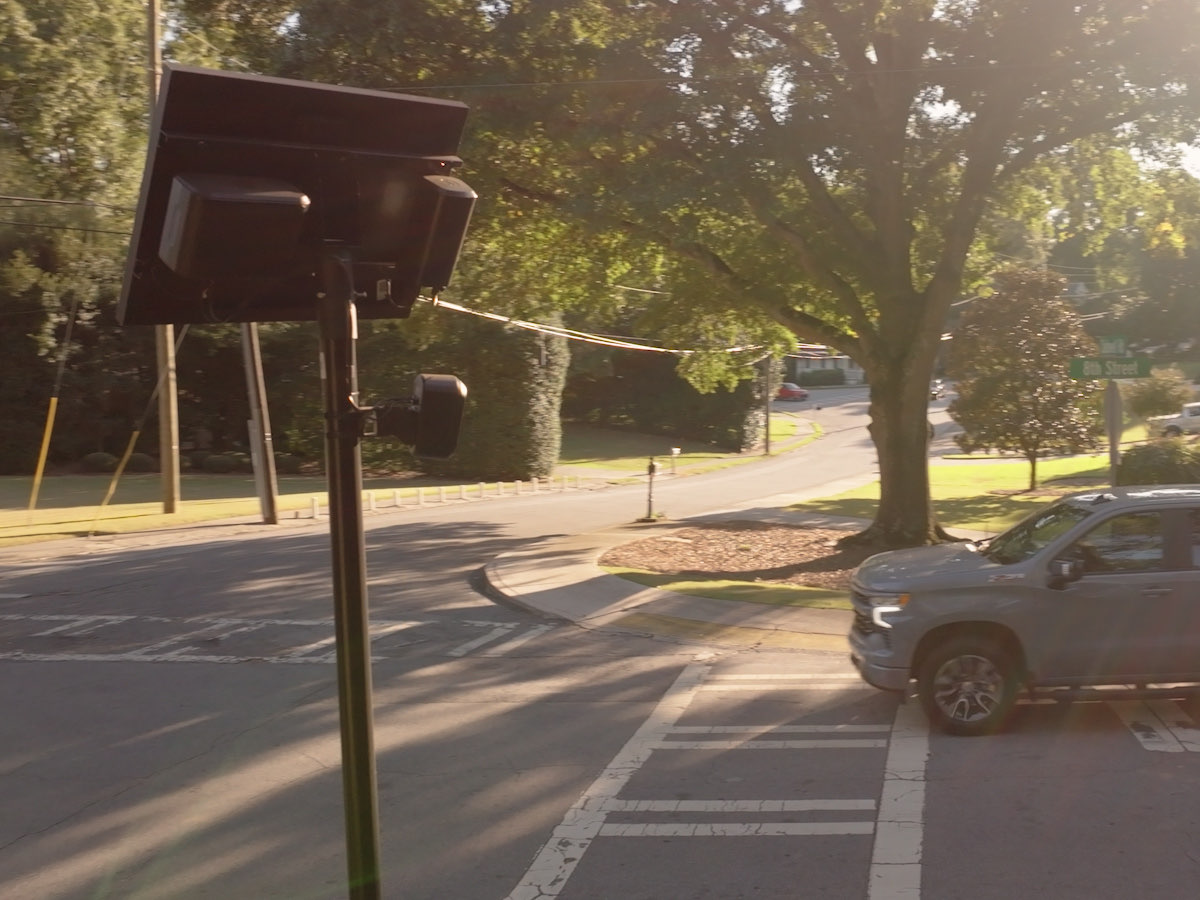
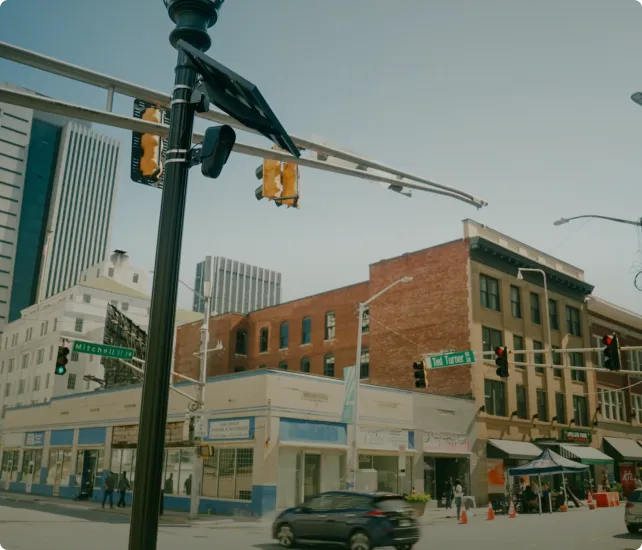
- Deployment and scale. Can coverage be added at jurisdiction edges without existing power, through solar and LTE?
For help mapping coverage at jurisdictional edges and regional connectors, see what is the right LPR deployment strategy for my city. For long-term cost and network value, see the price of “free” LPR.
Bring Your Region Onto a Unified Platform
Cross-jurisdictional crime moves fast. The agencies that respond fastest work from shared evidence, a shared map, and shared rules that every partner can defend. Flock was built to break down barriers between tools and agencies while keeping each agency in control of its own data.
Book a demo to see how Flock can connect your region on one platform.
Frequently Asked Questions
How do law enforcement agencies share license plate reader data across jurisdictions?
Agencies opt into a connected LPR network and choose which partner agencies can search their cameras, and for which offense types. Authorized users in partner agencies can then receive real-time hot list alerts and search shared detections by plate or vehicle description. Every search is logged and reviewable by the agency that owns the data.
Is vehicle data shared automatically between agencies?
No. Sharing is off by default and never automatic. Each agency decides whether to take part, which partners get access, and under what conditions. Every external access request requires explicit approval.
Can an agency limit what partner agencies search for?
Yes. With offense filtering, an agency can allow partners to search its cameras only for specific offense types, such as stolen vehicles, missing persons, or violent crime, and block searches that don’t fit its policy.
How can investigators locate a suspect vehicle without a full license plate?
Flock’s Vehicle Signature technology captures vehicle attributes such as make, body type, color, bumper stickers, and roof racks. FreeForm lets investigators search in plain language, so a partial plate or witness description can still produce a lead across shared networks.
How is cross-jurisdictional search activity audited?
Every search requires a reason and an offense type and is recorded with a user ID and timestamp. Supervisors can review search history, and Audit Assistance flags abnormal activity for administrator review. Agencies can also publish a Transparency Portal.
Does Flock use facial recognition or identify people?
No. Flock LPR captures a series of still images of a vehicle and cannot identify people. It does not use facial recognition, collect biometric data, or identify drivers or passengers.
How long is shared vehicle data kept?
Flock’s default retention period for new law enforcement customers is 7 days. Each agency can set a different period where local law or policy requires it. Evidence Mode lets investigators preserve specific data for an active investigation.


Protect What Matters Most.
Discover how communities across the country are using Flock to reduce crime and build safer neighborhoods.